The $2.5 Trillion Club: Why NVIDIA Overtaking Apple Signals a Shift in Market Power
For years, the hierarchy of Big Tech seemed set in stone. It was a race dominated by companies that controlled the devices in our pockets and the software on
The $2.5 Trillion Club: Why NVIDIA Overtaking Apple Signals a Shift in Market Power
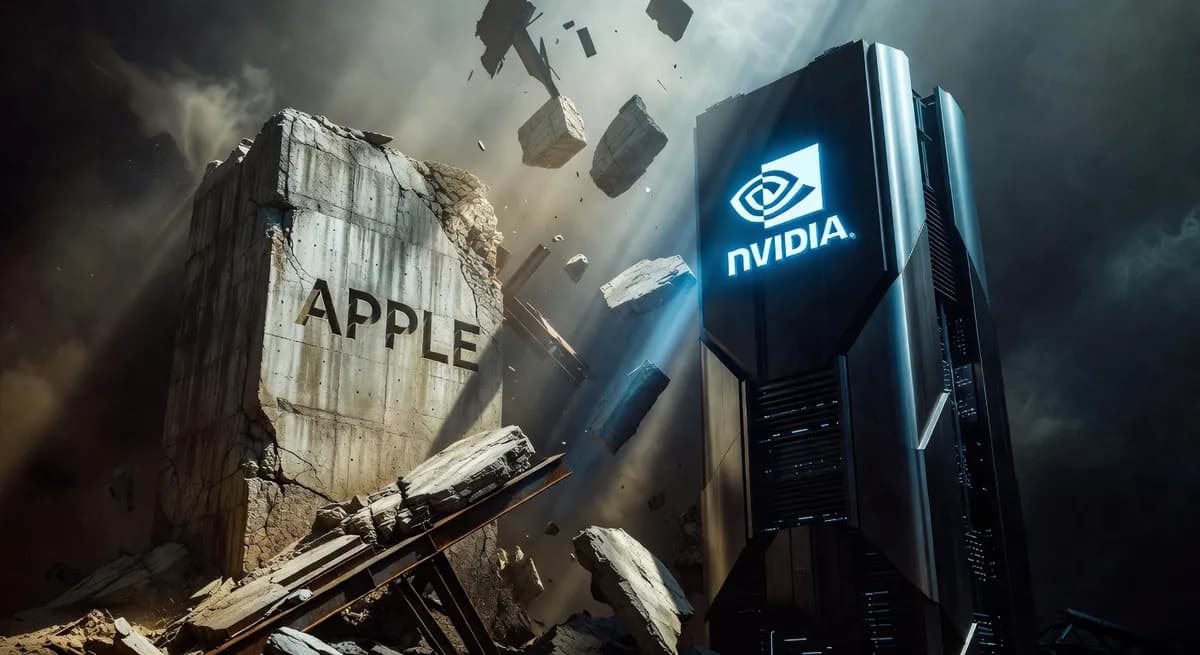
For years, the hierarchy of Big Tech seemed set in stone. It was a race dominated by companies that controlled the devices in our pockets and the software on our screens. But recently, the financial markets sent a shockwave through the industry that signals a new era: NVIDIA has overtaken Apple to become one of the most valuable companies in the world, joining the exclusive $2.5 trillion club alongside Microsoft.
While stock prices fluctuate day to day, this specific milestone is about more than just a temporary surge. It represents a fundamental reordering of market power. It signifies that the narrative of technology has shifted from the consumer interface to the industrial infrastructure that powers the digital age.
We are witnessing a pivot from the era of personal computing to the era of generative AI, and the capital flows are following the infrastructure.
From the Interface to the Infrastructure
To understand why this shift is so profound, we have to look at how these giants make their money. For decades, Apple was the undisputed king of the "interface." They captured value by designing beautiful, premium hardware—the iPhone, the Mac, the iPad—that served as the primary portal to the internet for billions of people. Their market power was derived from brand loyalty, ecosystem lock-in, and the sheer volume of consumer sales.
NVIDIA, by contrast, has always played a different game. They didn't try to own the device you hold; they focused on owning the engine room of the digital economy.
NVIDIA’s rise to the $2.5 trillion mark is built on the fact that they provide the essential shovels for the modern gold rush. While Apple sells the map, NVIDIA sells the heavy machinery needed to dig. As the world became obsessed with Generative AI and Large Language Models (LLMs), the demand for NVIDIA’s Graphics Processing Units (GPUs)—the specialized chips required to train and run these models—skyrocketed.
This overtaking of Apple signals that investors now value the "picks and shovels" of the AI revolution more highly than the consumer hardware endpoints. It suggests that the massive value creation in the next decade won't come from selling us better phones, but from building the intelligence that runs on them.
The Cloud and AI Symbiosis
For enterprise leaders and digital transformation strategists, this shift serves as a confirmation of the cloud computing model’s evolution. For years, "moving to the cloud" was the primary objective for CIOs. Today, the objective is "building intelligence on the cloud."
This is where NVIDIA’s dominance intersects with the strategies of hyperscalers like Microsoft, Amazon, and Google. These cloud providers are in an arms race to build the most powerful AI supercomputers. They are spending billions to equip their data centers with NVIDIA’s H100 and Blackwell chips.
This dynamic changes the nature of enterprise software. In the past, software companies competed on user experience and feature sets. In the future, the competitive moat will be defined by compute capacity and AI capability. NVIDIA holds the keys to that capacity.
The market is recognizing that the cloud is no longer just a storage locker for data; it is a factory for intelligence. The company that controls the raw processing power of that factory holds the leverage. NVIDIA’s valuation reflects their status as the de facto platform for the next generation of enterprise software.
Strategic Leadership and the Long Game
Beyond the technology and the financials, there is a lesson here in strategic leadership. It is worth noting that NVIDIA did not achieve this status overnight. CEO Jensen Huang has been preaching the vision of "accelerated computing" for over a decade.
While the rest of the world was focused on mobile apps and social media feeds, NVIDIA was laying the groundwork for parallel processing architectures. They bet the company on the idea that eventually, standard CPUs would not be enough to handle the massive computational loads of the future.
This serves as a stark reminder to entrepreneurs and executives: market dominance often requires planting seeds years—or even decades—before the harvest. NVIDIA capitalized on a specific technological inflection point, but they were only able to do so because they had cultivated the ecosystem (CUDA) and the hardware architecture long before the demand actually existed.
The shift in market power also highlights a change in how we view risk. Apple is a cash-cow with a predictable upgrade cycle. NVIDIA is riding a wave of hype and necessity that carries higher volatility but infinitely higher upside ceilings. The market’s preference for the latter right now indicates an appetite for aggressive growth and transformation over stability and consumer consolidation.
The New Hierarchy
As NVIDIA enters the $2.5 trillion club, we are seeing the formation of a new tech aristocracy. The throne is no longer occupied solely by those who control the user's attention; it is now shared with those who control the world's compute.
For businesses watching from the sidelines, the implication is clear. The most valuable resources of the next decade are not eyeballs or clicks, but teraflops and data intelligence.
NVIDIA overtaking Apple is not just a financial headline; it is a baton pass. It marks the official transition from the Mobile Era to the AI Era. The companies that understand this distinction—and align their strategies to leverage the infrastructure layer rather than just the application layer—will be the ones defining the future.